Scientific software / Research in progress
ExoCortexMBridge
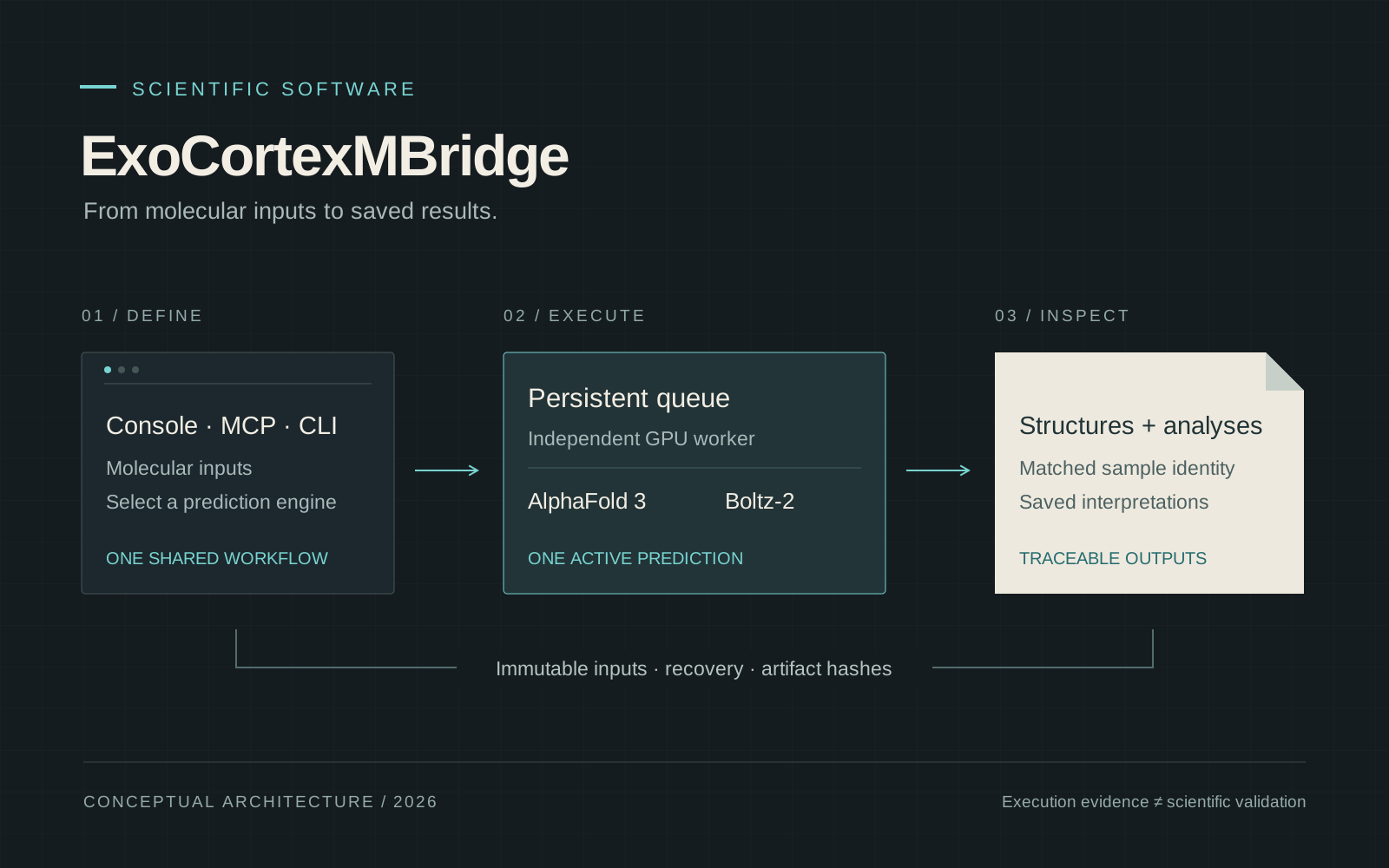
Run AlphaFold 3 and Boltz-2 jobs locally, review structures, and save each result with its inputs and analysis.
Abstract
From molecular inputs to saved results.
I built ExoCortexMBridge to manage molecular prediction jobs from one place. It connects AlphaFold 3 and Boltz-2 to a local interface for submitting inputs, viewing structures, and comparing results. Each saved prediction includes the inputs and settings used to produce it.
Long-running jobs can be recovered after an interruption. Structure measurements and reference comparisons are saved alongside the model output, so I can return to an earlier result without reconstructing the run by hand.
A possible protein development workflow
From a proposed protein to a testable design.
A researcher or protein design tool can supply candidate sequences for a protein intended to bind a target. ExoMBridge could help evaluate those proposals by running predictions, comparing structures and contacts, and keeping each input with its results. Laboratory experiments still determine whether the protein folds, binds its target, and performs its intended function.

This published experimental structure illustrates what a designed protein bound to its target can look like. Bim_fulldiff (chain A) and a BIM peptide segment (chain B) are shown from biological assembly 1 of PDB 8T5E. The structure comes from Vázquez Torres et al., “De novo design of high-affinity binders of bioactive helical peptides,” Nature 626, 435–442 (2024).
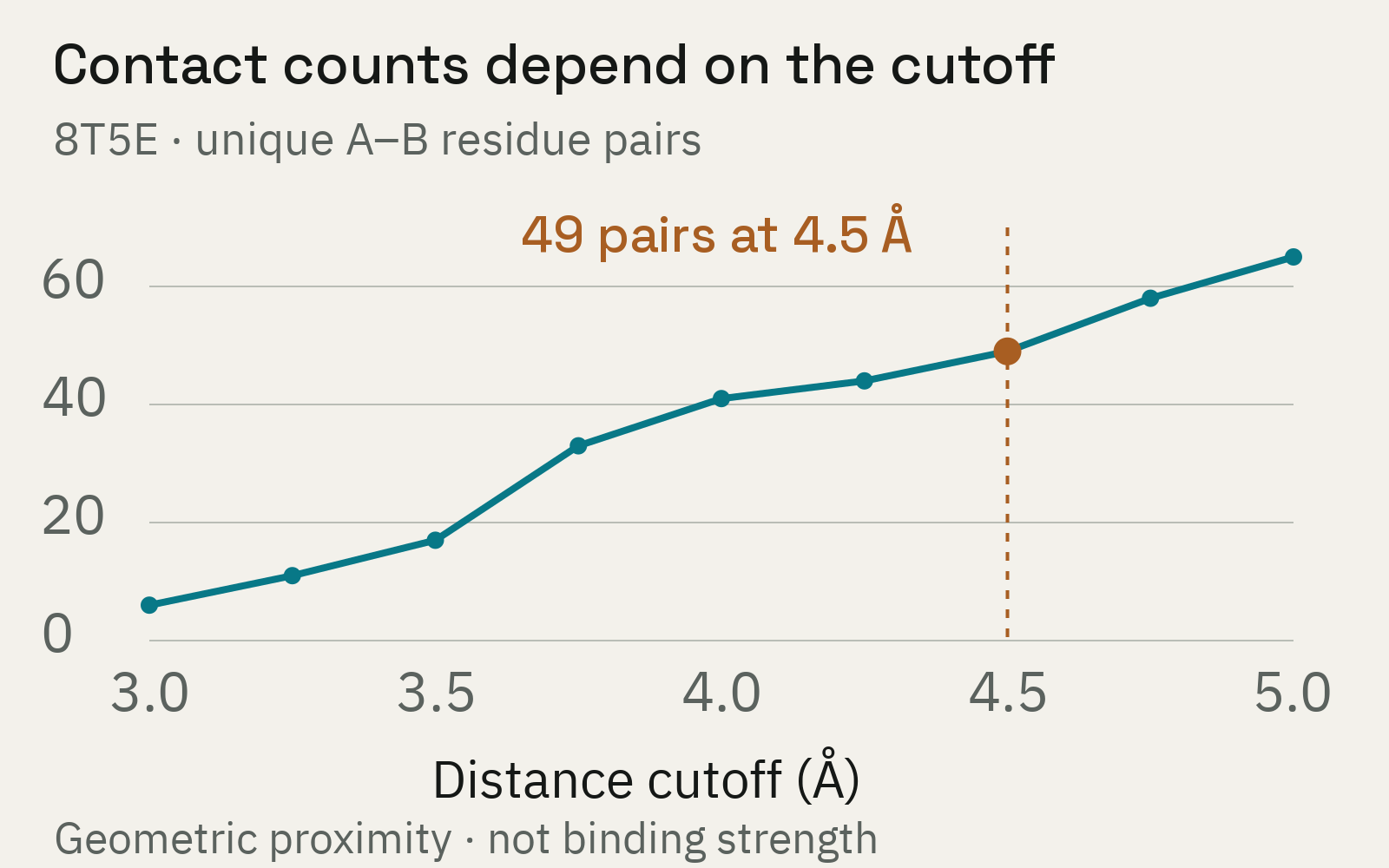
The rendering and contact analysis were performed locally using that public reference structure. Highlighted residues have a non-hydrogen atom within 4.5 Å of the other chain. This is spatial proximity, not a measurement of binding strength. The structure is from the published study; it is not an ExoMBridge prediction or a design produced by this project.
Public reference data
Reference-data check
Contact counts depend on the chosen distance cutoff. At 4.5 Å, this analysis of chains A and B finds 261 non-hydrogen atom pairs across 49 residue pairs. The plot shows how the residue-pair count changes with the cutoff.
An independent distance calculation reproduced the contacts, and rotating and translating both chains together preserved them. These checks test calculation consistency. They do not establish binding strength or the success of a new design.
Public inputs and analysis downloads
An earlier test run completed eight predictions across four molecular fixtures on September 23, 2026. These pilots tested job execution and the integrity of saved files. They do not establish biological validity, calibrated binding affinity, or clinical utility; computational seeds are not biological replicates.