The problem
A musical instruction can refer to several tracks, devices, or edits. Acting on an ambiguous interpretation can change the wrong part of a live set.
Creative technology / active
Translate musical instructions into typed Ableton Live actions that can be checked before execution.
A musical instruction can refer to several tracks, devices, or edits. Acting on an ambiguous interpretation can change the wrong part of a live set.
Desktop interface, language-to-action planning, and Ableton bridge engineering.
A local Ableton-control implementation with tested components for interpreting and checking actions before they reach the session.
Statusactive
Evidencetested
Record reviewed
Implementation
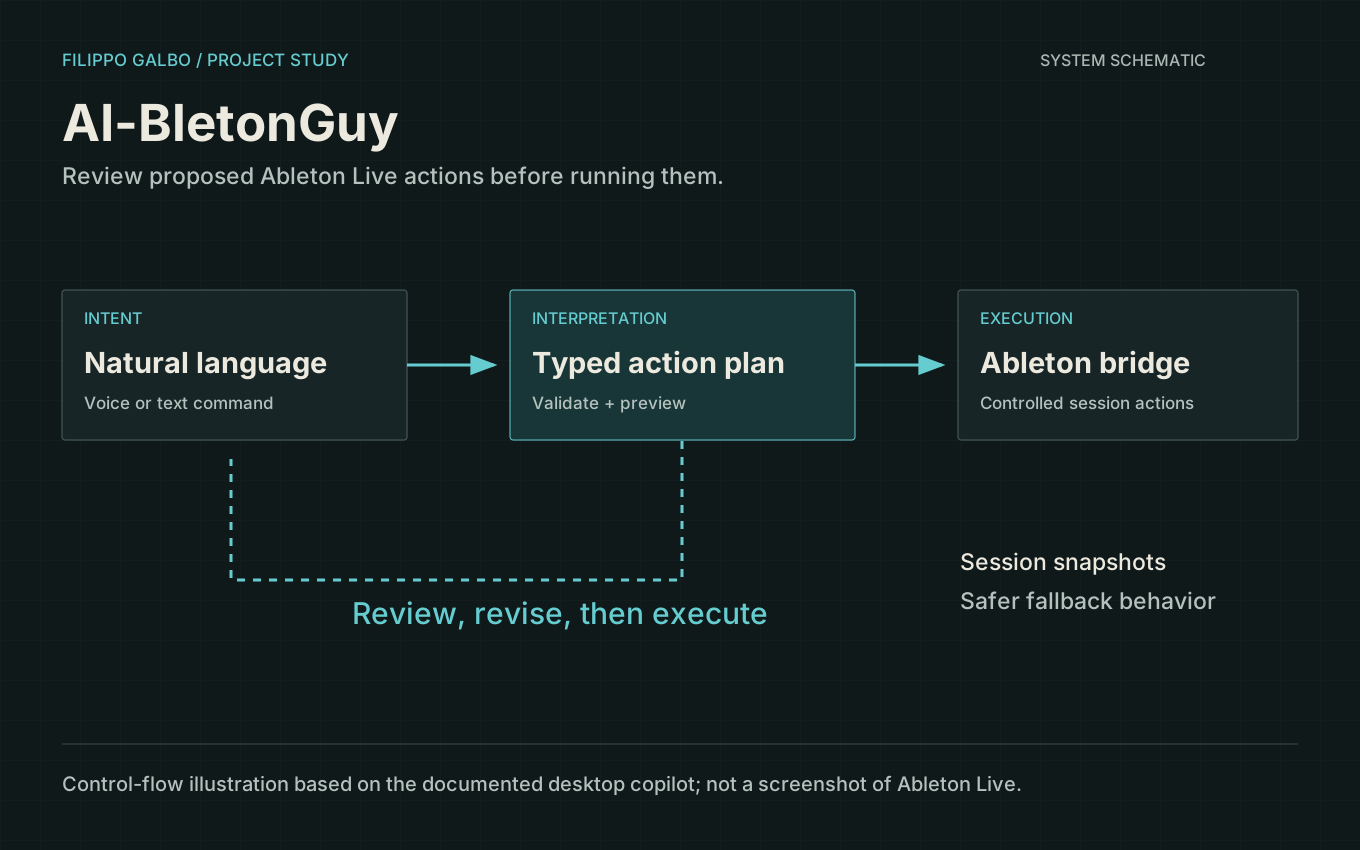
The desktop application parses natural-language input into a typed action plan, applies execution checks, and sends accepted actions through an Ableton bridge. Local-model routing and bridge failures remain visible to the operator.
The implementation includes desktop controls, bridge layers, safety rules, and operator documentation. Camera-to-MIDI and pose controls are separate experiments within the project.